





Last verified: September 1, 2026 — Rules were last checked against GDRFA.
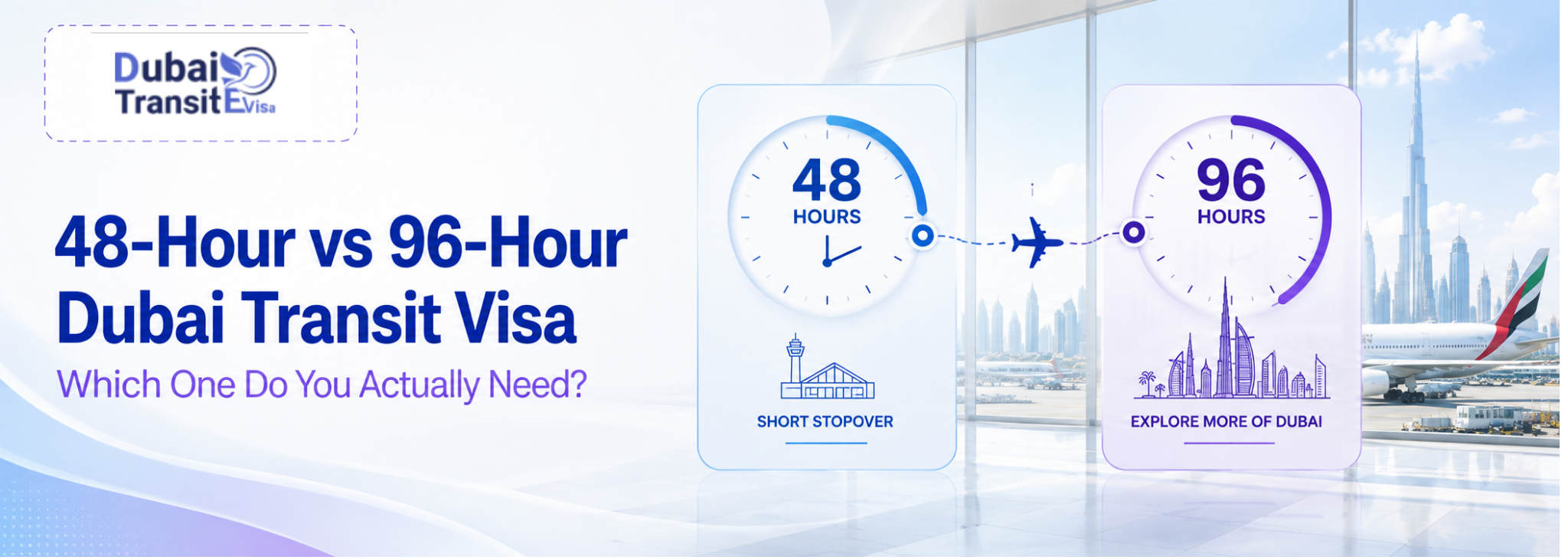
Take your layover in hours. If it is under 48, the 48-hour visa is enough. If it is over 48, you need the 96-hour one. That is the whole decision for most people.
The complications are worth knowing about, though, because the two visas differ in more than duration, and picking the cheaper one for a stay that turns out to be too long is an expensive way to save a small amount.
Side by side
| 48-hour transit visa | 96-hour transit visa | |
|---|---|---|
| Maximum stay | 48 hours from entry | 96 hours from entry |
| Suits a layover of | 8 to 48 hours | 48 to 96 hours |
| Government fee | No fee | AED 50 |
| Service fee | Depends on airline/approved intermediary | Depends on airline/approved intermediary |
| Total | Depends on provider | AED 120 official fee + applicable provider charges |
| Entries | Single | Single |
| Extendable | No published extension route | No published extension route |
| Sponsored by | Airline or approved agent | Airline or approved agent |
| Processing time | 48 hours | 48 hours |
When 48 hours is the right choice
You have a layover between roughly eight and forty-something hours, you want to see the city or sleep in a proper bed, and you will be back at the airport well inside two days.
This covers a large share of Dubai stopovers. A typical long connection, an overnight stop, a booked flight the following evening. For all of those, the shorter visa does the job at the lower price.
When 48 hours is a false economy
Three situations where the cheaper option costs you more.
Your layover is close to the line
A 46-hour layover on a 48-hour visa leaves you two hours of margin for a delayed inbound flight, an immigration queue and traffic on the way back. That is not margin, that is a gamble.
If your stop is over about 40 hours, take the 96-hour visa. The price difference is small next to the cost of an overstay.
Your plans might grow
People arrive in Dubai intending to stay one night and decide to stay two. On a 48-hour visa that decision is not available to you, and making it anyway means an overstay with a daily fine.
The current overstay fine is AED 50 per day after the applicable grace period.
Your onward flight is not firmly fixed
Standby, an award booking with limited availability, a connection that has changed once already. Anything with wobble in it argues for the longer visa.
When 96 hours is required rather than optional
If your layover is over 48 hours, the 48-hour visa is simply not valid for it. This is not a judgement call. Applying for a visa that expires before you leave is an overstay you have planned in advance.
The 96-hour visa also makes sense if you are deliberately building a stopover into a longer trip. Four days is enough to see Dubai properly rather than sprinting through it.
Can you extend, or move up from 48 to 96?
The short answer is that transit visas are not designed to be extended, and you should not plan around being able to.
There is currently no published GDRFA procedure for extending a 48-hour or 96-hour transit visa or upgrading a 48-hour transit visa to a 96-hour transit visa after entry. If you know you need longer, apply for the 96-hour visa from the beginning.
If you know you want longer, the cleaner route is usually to apply for the right visa in the first place, or to look at moving from a transit visa to a tourist visa before you travel rather than after you arrive.
What each visa costs, and what it does not include
The official GDRFA fees are:
- 48-hour transit visa: No issuance fee.
- 96-hour transit visa: AED 120 total — AED 50 issue fee, AED 50 application fee and AED 20 knowledge and innovation fee.
- Service fee: Any additional charge from an airline or authorised intermediary is separate from the official GDRFA fee and depends on the provider.
- VAT: Any applicable VAT or provider charges should be confirmed with the provider before payment.
Neither visa includes:
- Your flights
- Accommodation
- Travel or medical insurance, if you choose to buy it
- Any fine incurred if you overstay
Nationality restrictions
The 48-hour and 96-hour transit visas are available to eligible transit passengers, subject to UAE entry requirements and approval by the relevant authorities. The official transit-visa requirements do not currently list separate nationality restrictions for the 48-hour and 96-hour options.
Some travellers may be subject to additional entry requirements or checks based on their nationality, passport, travel history or individual circumstances.
If you are unsure whether your passport qualifies, check your eligibility with the airline or the relevant UAE immigration authority before booking your flights.
Which airport and airline each visa covers
Both visas permit entry to the UAE, so they work for arrivals at Dubai International, Al Maktoum, Abu Dhabi and Sharjah alike. What differs is who sponsors the application.
Airline-sponsored
Available if you fly a carrier that offers it on the route you are on, and usually only if the whole itinerary is with that airline or its partners.
Agent-sponsored
Available regardless of who you fly with, which matters if your itinerary is split across two airlines that have no relationship with each other.
Self-transfer itineraries built from separate tickets are the common case where no airline will sponsor you, and where the agent route is the only one open.
So which should you book?
A simple version:
Under 8 hours: neither. Stay airside.
8 to 40 hours: 48-hour transit visa.
40 to 48 hours: the 96-hour visa. The margin is worth more than the saving.
48 to 96 hours: 96-hour transit visa.
Over 96 hours: a tourist visa. Compare the two before deciding.
If you are still unsure, the deciding question is not "how long is my layover" but "what happens if my onward flight moves by six hours". If that answer is uncomfortable, buy the longer visa.
You can see how to apply for either, and the different types of Dubai transit visa covers the full range if your situation is unusual.