





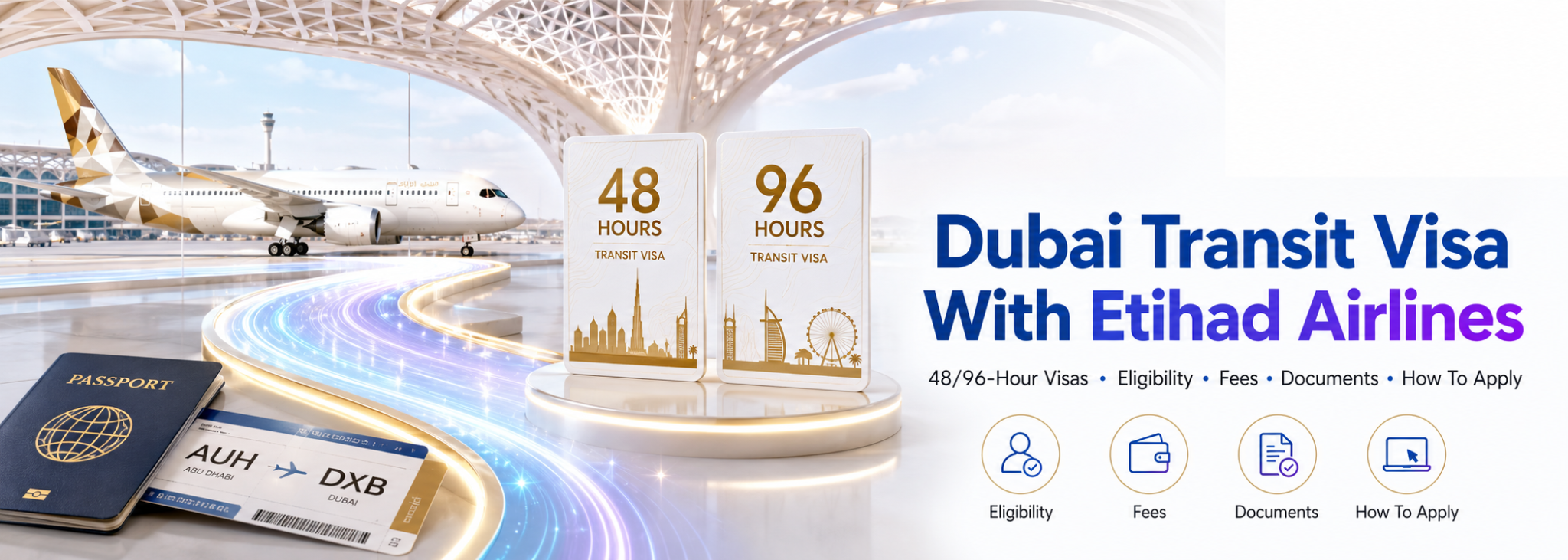
If you're flying Etihad Airways through the UAE and searching for a "Dubai transit visa," here's the important correction up front: Etihad flies into Zayed International Airport (AUH) in Abu Dhabi, not Dubai International (DXB). A transit visa sponsored through Etihad can only be used to leave the airport in Abu Dhabi — it does not grant entry to Dubai, and immigration will not treat it as such. If your goal is specifically to see Dubai during your layover, you need a different routing, which we cover below. This guide covers what an Dubai transit visa with etihad airlines actually gets you, 48 vs 96-hour options, AUH-specific eligibility, documents, fees, how the application actually works, what's reachable from AUH itself, and how this compares to routing through Dubai instead — all accurate for 2026.
Why Etihad ≠ Dubai: Understanding the AUH Routing
Etihad Airways is the UAE's Abu Dhabi-based national carrier, and every Etihad transit connection routes through Zayed International Airport (AUH) — a separate airport, in a separate emirate, roughly 140 km from Dubai International. That drive takes 1.5–2 hours depending on traffic on the E11 (Sheikh Zayed Road), which is a meaningful chunk of a short layover if you were hoping to squeeze in Dubai sightseeing.
Because of this geography:
- A transit visa sponsored by Etihad is valid for entry/exit only through AUH, per Etihad's own visa terms and conditions.
- You cannot use an Etihad-sponsored transit visa to leave via DXB, and immigration at DXB will not recognize it for that purpose.
- Even if you technically could reach Dubai by taxi from AUH within your visa window, your visa's legal basis for exiting the airport is tied to AUH specifically — this isn't just a practical inconvenience, it's how the visa is issued and sponsored.
- If you specifically want a Dubai layover experience, you'd need to fly a Dubai-based carrier (Emirates or flydubai) instead, since their transit visa sponsorship routes through DXB. See our Emirates transit visa guide or flydubai transit visa guide if that's your priority.
For travelers whose real goal is just "see something of the UAE during my layover" rather than Dubai specifically, Abu Dhabi holds up well as a destination in its own right — it has its own world-class attractions, described further down, all reachable without the cross-emirate drive.
Etihad (AUH) vs Emirates/flydubai (DXB): Quick Comparison
| Etihad via AUH | Emirates/flydubai via DXB | |
|---|---|---|
| Airport | Zayed International (AUH), Abu Dhabi | Dubai International (DXB) |
| Transit visa valid for | Abu Dhabi only | Dubai only |
| Key attractions reachable | Grand Mosque, Louvre Abu Dhabi, Yas Island, Corniche | Burj Khalifa, Dubai Mall, Marina, Old Dubai |
| Distance between the two cities | ~140 km / 1.5–2 hrs drive | — |
| Can you "do both" on one visa? | No — visa is airport-specific | No — visa is airport-specific |
Types of Etihad-Sponsored Transit Visas: 48 vs 96 Hours
48-Hour AUH Transit Visa
- Ideal for shorter layovers — enough time for a focused half-day or full-day in Abu Dhabi.
- Allows exit through AUH and up to 48 hours in the city from your entry stamp.
- Non-extendable; must be used within the visa's entry window from issue date, typically 30 days.
- Best suited to a tight circuit: Grand Mosque in the morning, Corniche in the afternoon, back to the airport with buffer time.
96-Hour AUH Transit Visa
- Suited to longer layovers, generally anywhere from 8 up to 96 hours.
- Valid for up to four full days in Abu Dhabi from entry.
- Enough time for the Grand Mosque, Louvre Abu Dhabi, a full day at Yas Island (Ferrari World, Yas Waterworld, Yas Marina Circuit), and a relaxed Corniche walk without rushing between them.
- Worth the modest extra cost if your connection genuinely allows it, since Abu Dhabi's major sights are spread out enough that 48 hours can feel rushed.
Both visa types require your onward flight to be Etihad-operated (not a codeshare with another carrier), with a ticket number reflecting Etihad's own numbering series, plus a confirmed booking to a third country departing within the visa window.
Who Needs This Visa — and Who Doesn't
You need the transit visa if:
- You plan to exit AUH during your layover — for sightseeing, a hotel stay, or visiting contacts.
- Your layover exceeds roughly 8 hours and you want to leave the airport rather than wait airside.
- You're connecting to a third country via Abu Dhabi on Etihad, with a genuine stopover rather than a direct flight.
You don't need it if:
- You remain airside at AUH without clearing immigration — many short Etihad connections work this way by design.
- Your layover is short enough that staying inside the terminal is the more sensible plan anyway.
- Your nationality already qualifies for UAE visa-free entry or visa-on-arrival — always check your specific passport's eligibility before assuming a transit visa application is necessary, since applying for a visa you don't need just adds cost and processing time.
Documents Required for an Etihad AUH Transit Visa (2026)
- Valid passport (minimum 6 months validity from your arrival date)
- Confirmed onward flight ticket to a third destination, Etihad-operated, departing within your visa's validity window
- Recent passport-sized photo (white background, high resolution, no shadows)
- Proof of accommodation in Abu Dhabi — recommended for shorter stays, generally required for the 96-hour option
- Valid travel insurance (recommended, though not always mandatory depending on service tier)
Minors and Families
- Birth certificate for minors, plus a consent letter if traveling with only one parent or guardian.
- Families are generally best served applying together so hotel and itinerary details stay consistent across applications.
Fees and Processing Time
- 48-hour transit visa: Often free or low-cost when sponsored directly by Etihad for genuinely connecting passengers who book correctly through Etihad's own channel; a paid express service is available for faster or independently-arranged processing.
- 96-hour transit visa: Typically falls in the AED 50–150 range depending on service tier, though Etihad's own free sponsorship may still apply for qualifying itineraries — it's worth checking both Etihad's official visa page and a paid service like ours before assuming you'll be charged.
- Processing time: Generally 24–72 hours for standard processing; express options exist for travelers with tighter connections who need a faster turnaround.
Etihad's own free transit visa sponsorship exists specifically for passengers who qualify under their terms. A paid service like ours becomes useful for travelers who need faster processing, document verification and rejection-risk review, or support when their itinerary doesn't cleanly qualify for Etihad's free option — for example, mixed-carrier bookings or unusual layover lengths.
How to Apply for an Etihad-Sponsored AUH Transit Visa
- Check eligibility directly via Etihad's official visa channel first — many qualifying passengers get this visa free when booked correctly through Etihad, so it's worth ruling that out before paying for a separate service.
- If you need faster processing or extra support, apply via Dubai Transit Visa, selecting the Abu Dhabi/AUH transit visa option specifically — not a generic "Dubai" option.
- Fill in your passport and Etihad flight details accurately — your ticket number and routing must match what's on file, since mismatches are a common cause of delay.
- Upload required documents and a clear photograph, checked against the specs above.
- Complete payment securely online, where a paid service applies.
- Receive your approved e-visa via email; print a copy and keep a digital backup for AUH immigration.
For the full Abu Dhabi-specific process beyond just the Etihad angle, see our dedicated Abu Dhabi transit visa guide.
Common Application Mistakes to Avoid
- Selecting a generic "Dubai transit visa" option when you actually need the AUH-specific one.
- Submitting a codeshare ticket number instead of Etihad's own numbering — this is one of the most common rejection triggers for this specific visa.
- Skipping Etihad's own free-visa check and assuming you must pay.
- Booking accommodation in Dubai instead of Abu Dhabi, then discovering your visa doesn't cover the trip there.
Things to Do in Abu Dhabi During Your Etihad Layover
Since your transit visa is valid for Abu Dhabi, not Dubai, it's worth planning around what's genuinely reachable from AUH rather than mentally substituting in Dubai's landmarks.
Sheikh Zayed Grand Mosque
One of the world's largest mosques and Abu Dhabi's most recognizable landmark, open to visitors outside prayer times. Modest dress is required (robes are provided at the entrance if needed), and it's roughly a 20–25 minute drive from AUH.
Louvre Abu Dhabi
A major art and civilization museum on Saadiyat Island, with a rotating collection spanning global history and culture — a strong pick if your layover falls during museum opening hours.
Yas Island
Home to Ferrari World, Yas Waterworld, and the Yas Marina Circuit (Abu Dhabi's Formula 1 venue). This cluster works best with the 96-hour visa, since a single theme park visit alone can take most of a day.
Corniche Abu Dhabi
A long waterfront promenade with beach access, cycling paths, and skyline views — a good lower-effort option if you're short on time or energy after a long-haul flight.
Qasr Al Watan
The UAE's presidential palace, open to the public with guided and self-directed tour options, showcasing Arabian architecture and design.
All five sit within a reasonable drive of AUH — generally 20–40 minutes — unlike Dubai's landmarks, which would eat most of a short layover just in transit time.
A Note on Etihad's Onboard and Airport Experience
Etihad has built a reputation around premium hospitality on long-haul routes, and AUH itself offers standard modern airport amenities — lounges, duty-free shopping, dining options, and rest areas — for passengers who prefer to stay airside rather than apply for a transit visa at all. If your connection is under 8 hours, weigh the hassle of a visa application and the AUH-to-city drive against simply resting in the terminal.
Common Mistakes Etihad Passengers Make
- Assuming an Etihad transit visa lets them visit Dubai — it doesn't, and immigration will not honor it for that purpose.
- Booking a non-Etihad onward flight (a codeshare or separate carrier) and expecting Etihad's sponsorship terms to still apply.
- Not checking Etihad's own free transit visa eligibility before paying for a third-party service.
- Missing the AUH-specific document and ticket-number requirements described above.
- Planning an itinerary around Dubai attractions before realizing the visa doesn't cover the trip there.
Why Apply with Us?
- Accurate guidance on AUH vs DXB routing before you apply for the wrong visa type
- Fast processing with real-time status updates
- Secure payment gateway
- 24/7 professional support for questions specific to Etihad's routing and documentation requirements
Final Thoughts & Call to Action
An Etihad layover is a genuine opportunity to see Abu Dhabi — not Dubai. Once you understand the AUH routing and plan around what's actually reachable from Zayed International Airport, applying for the right visa and building an itinerary around the Grand Mosque, Louvre Abu Dhabi, and Yas Island makes for a memorable stopover in its own right, rather than a compromised attempt at reaching Dubai.
Apply for your Abu Dhabi (AUH) transit visa via Dubai Transit Visa and get the routing right the first time.